Planning a Packaging Program? Talk to Our Management Team
Share your product needs, quantity and destination market. We’ll review your requirements and help confirm suitable options, MOQ, customization and next steps.
Discuss Your Packaging Program with Our Management Team
Our Leadership Team
Not sure which material, size or product format fits your application? Share your product use, estimated quantity, destination market, branding and documentation requirements. Our team will recommend suitable options and help confirm MOQ, samples, lead time, packing and available compliance documents.
Support for Your Enquiry
Product and material matching
Annual volume and capacity planning
Private-label portfolio development
Quality, compliance and delivery governance
Need a Quick Quote? Talk to Our Sales Team
Share your product needs, quantity and destination market. We’ll help confirm suitable options, MOQ, pricing and next steps.
Need a Quick Quote or Help Matching the Right Product?
Our Product & Export Support Team
Share your product type, dimensions, estimated quantity, destination market and customization requirements. Our sales team will help identify suitable options and confirm pricing, MOQ, samples, lead time, packing and available compliance documents.
Support for Your Enquiry
Product and material matching
MOQ, samples and lead time
OEM printing and packing options
Documentation for destination markets
Planning a Packaging Program? Talk to Our Management Team
Share your product needs, quantity and destination market. We’ll review your requirements and help confirm suitable options, MOQ, customization and next steps.
Discuss Your Packaging Program with Our Management Team
Our Leadership Team
Not sure which material, size or product format fits your application? Share your product use, estimated quantity, destination market, branding and documentation requirements. Our team will recommend suitable options and help confirm MOQ, samples, lead time, packing and available compliance documents.
Chemical Migration in Bagasse Food Packaging: Buyer Safety Guide
A customer once sent me a “food grade certificate” for a molded fiber lunch tray.
One page.
Beautiful logo, big stamp, clean border, the usual lab-report theatre — but no contact temperature, no simulant, no contact duration, no mention of fatty food, no surface-area ratio, and absolutely nothing about whether the tray would be used for dry biscuits or hot rice with oily chicken and chili sauce sweating under a closed lid.
Would you sign off on that?
I wouldn’t. And from my experience, this is exactly where buyers get burned. Not because every supplier is lying. That would be too simple. The real problem is messier: plenty of suppliers send documents that are technically “something,” but not enough to prove the actual food-contact use you’re buying for.
Here’s the ugly truth.
“Food grade” is procurement slang until the migration file proves it.
Why “Food Grade” Is Too Lazy for Hot Takeout
But the box looks natural, right?
That’s the trap. Bagasse packaging has that safe-looking beige fiber finish. No glossy plastic. No chemical smell, if the production is decent. It feels earthy. Compostable. Clean. Buyers relax too early.
Wrong move.
Chemical migration in food packaging means substances move from the finished food-contact article into food. Not in theory. In use. With heat, oil, acid, steam, pressure, stacking, moisture, microwave abuse, delivery time, and the kind of menu nobody wants to simulate because the result might be uncomfortable.
So when someone tells me, “This bagasse clamshell is food grade,” I don’t nod.
I ask: for what food, at what temperature, for how long?
Bagasse Isn’t the Whole Story. The Formulation Is.
Raw sugarcane fiber isn’t usually the villain in this story.
The risk often sits around the fiber: wet-end additives, oil-resistance chemistry, water barrier systems, surface coatings, mold-release residues, process aids, inks, labels, adhesives, and the weird little non-intentionally added substances nobody wants to talk about until a lab chromatogram starts looking noisy.
That’s factory reality.
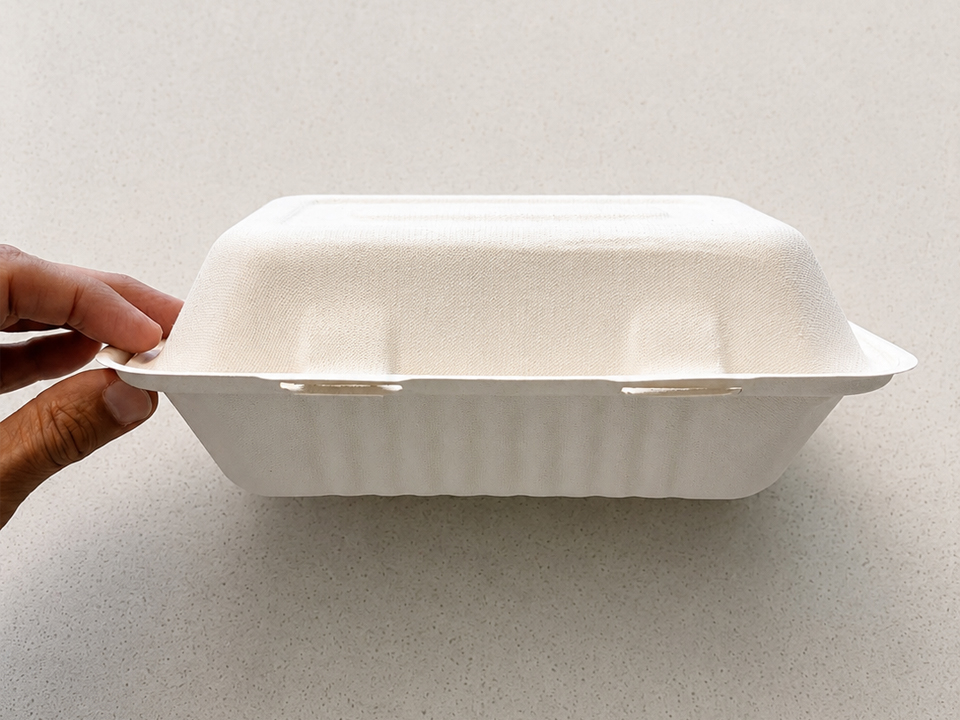
A buyer looking at a bagasse clamshell takeout box for food packaging shouldn’t stop at size, case pack, lid fit, and compostability claim. Those matter, yes. But the real approval question sits deeper: has the final clamshell been tested under conditions close to the actual menu application?
Dry bakery?
Fine, different conversation.
Fried chicken, curry rice, tomato pasta, burger grease, hot noodles, or delivery food trapped under steam for 45 minutes? That’s a different beast. And if the supplier uses the same one-page certificate for all of those use cases, I’d put that file straight into the “needs QA escalation” pile.
PFAS Was the Wake-Up Call Buyers Tried to Sleep Through
PFAS used to be treated like a sustainability issue. Then it became a food-contact issue. Now it’s a commercial risk issue.
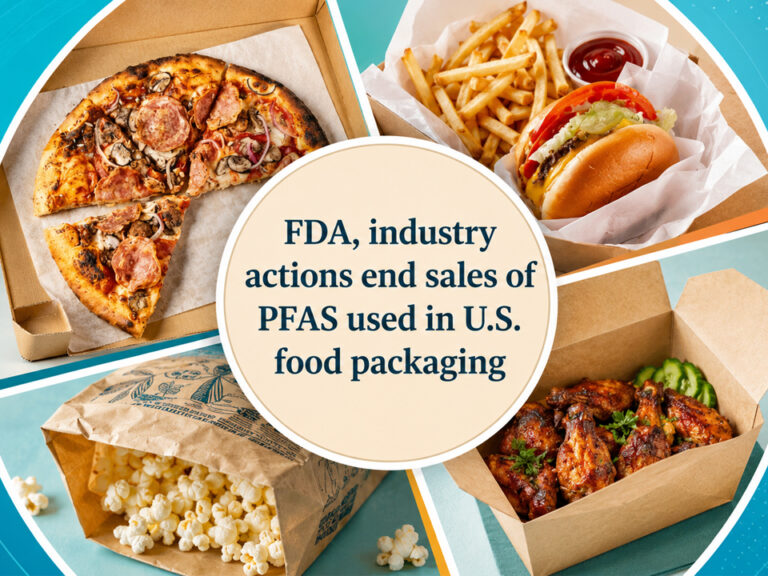
On February 28, 2024, the FDA announced that grease-proofing substances containing PFAS were no longer being sold by manufacturers for food contact use in the U.S. market. These substances had been used in paper and paperboard food packaging applications such as fast-food wrappers, microwave popcorn bags, takeout paperboard containers, and pet food bags. The FDA update is here: PFAS grease-proofing agents no longer being sold in U.S. food packaging.
Then came another shove. On January 3, 2025, FDA determined that 35 food contact notifications related to PFAS were no longer effective, with a compliance date of June 30, 2025 for certain existing food paper packaging. That notice is here: 35 PFAS-related food contact notifications no longer being effective.
Does that mean every bagasse box has PFAS?
No.
But it does mean “PFAS-free” can’t just be a sales line slapped into a catalog. Buyers should ask for the test method, reporting limit, sample identity, and whether the tested article includes the same coating system as mass production. Total fluorine? Targeted PFAS? Which lab? Which batch? Which article?
Annoying questions.
Good questions.
The EU is tightening too. Regulation (EU) 2025/40, the Packaging and Packaging Waste Regulation, entered into force on February 11, 2025 and will generally apply from August 12, 2026. Food-contact packaging faces PFAS restrictions under that wider framework, and the European Commission lays out the timeline on its packaging waste regulation page.
My controversial opinion: any molded fiber supplier selling into Europe for 2026 programs without a real PFAS control file is not “a little behind.” They’re a liability wearing a green label.
Overall migration testing sounds like the kind of phrase people skip in a report.
Don’t.
Overall migration testing measures the total quantity of non-volatile substances transferring from a food contact material into food or food simulants under defined conditions. It doesn’t identify every chemical one by one. It’s more like a broad cleanliness signal for the finished article.
That’s useful.
Under EU Regulation (EU) No 10/2011 for plastic food contact materials, the overall migration limit is 10 mg/dm². Bagasse fiber itself is not plastic, obviously, but many molded fiber items use coatings, barrier layers, or laminated systems that can pull plastic food-contact logic into the approval discussion. You can check the legal text at EUR-Lex Regulation (EU) No 10/2011, while the wider EU food contact material framework is summarized on the European Commission’s food contact materials legislation page.
Here’s where buyers mess up.
They see “Pass” and stop reading.
Bad habit.
A useful migration report should show the test method, sample description, contact side, simulant, temperature, contact time, result, limit, surface-area calculation, report date, lab accreditation, and whether the tested article matches the SKU being purchased. If the report only says “bagasse container” while your order is for a coated, hinged, compartment clamshell with printed sleeve, you’ve got a gap.
Maybe a big one.
The Buyer’s Test Matrix: What Actually Changes Migration Risk
I’ve watched buyers argue for two hours over lid stacking height and then approve migration paperwork in 90 seconds.
That’s backwards.
Risk factor
Why it matters
Buyer question to ask
Time
Longer contact can increase migration, especially for delivery, storage, or meal prep
Was the test run for the longest realistic contact time?
Temperature
Heat can accelerate migration from coatings, additives, and residues
Was hot-fill, steam, microwave, or reheating exposure simulated?
Food type
Fat, acid, water, alcohol, and dry foods extract different substances
Which food simulant was selected, and does it match the menu?
Surface area
Small packs or compartment trays may expose more packaging area per food mass
Was the surface-area-to-food-volume ratio calculated?
Coating
Barrier chemistry may drive more risk than the fiber itself
Was the finished coated article tested, or only raw pulp?
Additives
Wet-strength agents, oil resistance chemistry, and process aids can matter
Are additives covered in the supplier compliance statement?
Printing
Ink can migrate by set-off or indirect transfer
Was the printed version tested, or only the blank item?
Batch variation
Pulp, coating weight, drying curve, and line settings can shift results
Is there change control and periodic retesting?
This is why approving a molded fiber clamshell box for takeout food packaging should never be a shape-only decision. A burger clamshell and a sauced rice clamshell may look similar on a spec sheet, but the migration risk profile is not the same.
One holds grease.
One holds chemistry questions.
The 3,601-Chemical Number Should Make QA Teams Less Relaxed
In September 2024, research published in the Journal of Exposure Science & Environmental Epidemiology reported systematically compiled evidence of human exposure to 3,601 food contact chemicals. The study, Evidence for widespread human exposure to food contact chemicals, found those chemicals in human samples and framed food contact materials as part of the broader exposure conversation.
Now, don’t twist this.
It doesn’t mean bagasse packaging is automatically dangerous. It doesn’t mean all 3,601 chemicals came from molded fiber. It doesn’t mean every detected substance is illegal or equally hazardous.
But it destroys the lazy comfort sentence: “Packaging is regulated, so it must be fine.”
That sentence is procurement junk food.
Real safety depends on the material, formulation, use conditions, exposure, toxicology, compliance route, and production control. If your supplier changes coating chemistry after your first order and nobody tells you, your old report might be a souvenir, not protection.
BPA Is Not the Bagasse Story. It’s the Warning Story.
BPA isn’t the headline risk for sugarcane fiber boxes.
Still, buyers should study it.
On April 19, 2023, EFSA announced a new tolerable daily intake for BPA of 0.2 nanograms per kilogram of body weight per day, around 20,000 times lower than the previous temporary level. EFSA also said dietary exposure to BPA was a health concern across age groups. Their release is here: Bisphenol A in food is a health risk.
The lesson is nastier: substances once considered manageable can become unacceptable after updated risk assessment. Science moves. Regulators move. Retailers move even faster when their brand is exposed.
If your supplier file is full of reports from 2021 and nobody has reviewed them since, that isn’t compliance.
That’s archaeology.
What a Serious Bagasse Migration File Should Look Like
A good compliance file is usually boring.
That’s a compliment.
It won’t be a glossy certificate with five logos and vague claims. It’ll be a stack of traceable, slightly annoying documents that answer exactly what the buyer needs to know. Sample identity. Test conditions. Intended use. Food simulants. Limits. Results. Lab details. Restrictions.
Ask for these before you approve commercial supply:
Finished-article migration report Not raw pulp. Not a similar tray. The actual molded, coated, hinged, printed, or treated article.
Overall migration testing A broad check on the total transfer of non-volatile substances.
Specific migration testing Needed when substances have limits, known concern, or regulatory relevance.
PFAS screening For molded fiber food packaging, I’d want targeted PFAS analysis, total fluorine where relevant, and a PFAS-free supplier declaration that doesn’t read like marketing copy.
Heavy metals testing Especially when pulp, colorants, inks, fillers, or non-virgin inputs enter the discussion.
Sensory testing Odor and taste transfer can kill a foodservice account even when the legal file looks clean.
Coating and additive compliance statement Trade secrets are one thing. Total silence is another.
Declaration of Compliance or food contact statement It should reference the target market, intended use, applicable rules, and any restrictions.
Change-control agreement If coating, pulp source, ink, additive system, mold, or production line changes, the buyer should be notified.
Retesting schedule High-volume foodservice SKUs shouldn’t live forever on one old report.
When sourcing a molded fiber clamshell takeout food box, treat the compliance file as part of the product. Not an attachment. Not admin work. Part of the product.
Because if the box fails a buyer audit, it doesn’t matter how nice the hinge feels.
The Fake Comfort of a One-Page Certificate
I hate one-page certificates.
Not always. But often.
Some are legitimate summaries. Plenty are not. The bad ones use broad phrases like “FDA approved,” “food safe,” or “complies with food grade standard,” while hiding the only details that matter: tested article, test conditions, contact type, food simulant, and intended use.
Here’s my rule: the less specific the certificate, the less trust it deserves.
Ask this:
Is this report for the finished article or only raw material?
Does it include the coating?
Does it include the food-contact side?
Does it cover hot food?
Does it cover fatty food?
Does it cover acidic food?
Does it cover microwave reheating?
Does it cover printed versions?
Is the lab ISO/IEC 17025 accredited?
Is the report current?
Does the sample photo match the SKU?
Are restrictions stated clearly?
If the supplier gets irritated, good.
You just learned something.
Strong factories answer these questions because their QA team already has the paperwork. Weak ones forward a certificate from sales and hope you’re too busy to read the fine print.
How to Test Bagasse Packaging for Chemical Migration
Start with the menu, not the catalog.
That sounds obvious, but procurement teams still do it backwards. They pick a clamshell, negotiate price, confirm case pack, ask for “FDA,” and only later realize the customer wants to use the box for hot oily food under delivery conditions. At that point, the supplier is already emotionally attached to the order and nobody wants new testing because it may delay shipment.
Do it properly.
Step 1: Define the food profile
The lab needs to know what the packaging will touch. A dry muffin is not a chicken wing. Cold salad is not curry. A tomato-based pasta dish behaves differently from plain rice.
Group the food first:
Dry food
Aqueous food
Acidic food
Fatty or oily food
Dairy
Alcohol-containing food
Hot-filled food
Frozen food
Microwave-reheated food
Hot and fatty is where I start paying closer attention. Hot, fatty, acidic, and closed-lid delivery? That’s where I stop trusting generic paperwork altogether.
Step 2: Define time and temperature
Don’t let the supplier pick the easiest test condition.
A real takeout box may see 85°C food, steam condensation, 30 to 60 minutes of closed-lid delivery, warehouse storage before use, and maybe microwave reheating by the consumer. FDA chemistry guidance is blunt enough here: migration data should reflect the most severe temperature and time conditions expected for the intended use.
That sentence matters.
Use it.
Step 3: Test the final article
Flat-sheet testing is not the same as finished-pack testing.
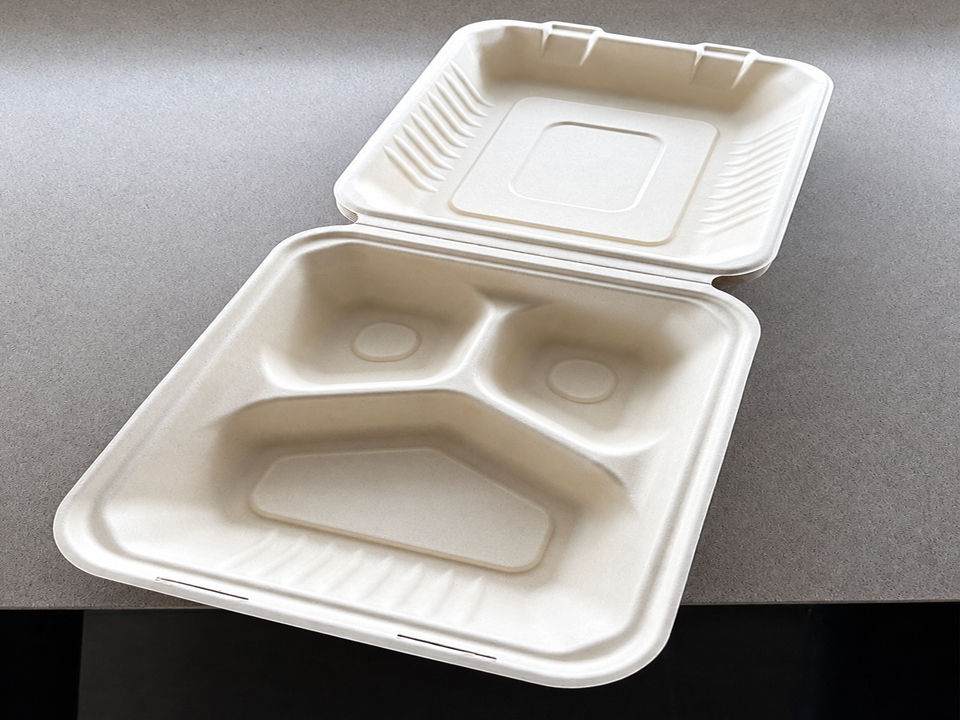
A molded clamshell has corners, ridges, hinge stress, thickness variation, trimmed edges, lid contact, and sometimes coating-weight variation. If the coating is applied after molding, test after coating. If the item is printed, test printed or justify why blank testing is enough. If the box has compartments, don’t pretend the contact geometry is the same as a flat plate.
Factory people know this.
Buyers should too.
Step 4: Build the test scope
For bagasse food contact material testing, a practical scope may include:
Overall migration testing
Specific migration testing
PFAS screening
Total fluorine where relevant
Heavy metals
Formaldehyde or wet-strength-related substances where relevant
Fluorescent whitening agents when paper/fiber inputs raise concern
Sensory testing
NIAS screening for higher-risk or private-label programs
No, every SKU doesn’t need every possible test.
But every SKU needs a logic. Why these tests? Why these conditions? Why this simulant? Why this article? If nobody can answer, the file isn’t finished.
Surface Area: The Boring Detail That Bites Later
Surface area sounds like lab math.
It’s also exposure math.
A small container can have a high packaging-contact area relative to the mass of food. A compartment tray can expose more walls and corners than a flat plate. A sauce cup holding oily dressing may create a more aggressive contact scenario than a large plate holding bread.
So don’t approve by material family alone.
“Bagasse” is not enough. “Molded fiber” is not enough. Even “same supplier” is not enough if the SKU shape, coating, or menu use changes.
This is why serious buyers approve by SKU and intended use. It feels slow at first. It’s cheaper than explaining a recall, a retailer rejection, or a failed compliance audit later.
Buyer Risk Ranking: Which Bagasse Applications Need More Testing?
Some applications deserve more scrutiny than others. I’d rank them like this.
Application
Migration concern
Testing priority
Dry bakery tray
Lower moisture and fat contact
Medium
Cold salad bowl
Moisture, acid, dressing contact
Medium to high
Burger clamshell
Grease, heat, steam, short delivery time
High
Fried chicken box
High oil, heat, prolonged contact
High
Curry or chili rice container
Oil, acid, heat, staining, steam
Very high
Soup bowl
Heat, liquid contact, coating stress
Very high
Microwave reheating container
Elevated temperature and consumer misuse
Very high
Printed private label box
Ink, set-off, brand exposure
High
Here’s where I get blunt.
If your customer is using the same bagasse box for salad, noodles, fried chicken, and sauced rice — and your compliance file only supports “general food contact” — you don’t have a tested use case. You have a hope-based approval system.
Hope doesn’t pass audits.
Supplier Questions I’d Ask Before a Purchase Order
These are not polite brochure questions. These are buyer-protection questions.
Ask them before the PO, not after the container is on the water.
Which food contact regulations does this exact item comply with?
Is the report for the finished article or only raw material?
What coating or oil-resistance system is used?
Is the article intentionally PFAS-free?
Which PFAS test method was used?
What reporting limit or detection limit applies?
Which food simulants were selected?
What time and temperature conditions were used?
Does the report cover hot food?
Does the report cover fatty food?
Does the report cover acidic food?
Does the report cover microwave reheating?
Was overall migration testing performed?
Was specific migration testing performed?
Were inks, labels, sleeves, or adhesives included?
What changes trigger retesting?
Can you trace the tested sample to production?
How often do you retest?
If the answer is “yes, friend, no problem,” ask again.
I’m serious.
“No problem” is not a compliance document. It’s a sales reflex.
Where Molded Fiber Buyers Usually Get Tricked
The most common mistake is approving a product family instead of an article.
A buyer gets one report for a “bagasse container,” then applies it across clamshells, bowls, trays, plates, and compartment boxes. Convenient? Sure. Defensible? Not always.
Another mistake: ignoring the coating.
In molded fiber, the coating can be the difference between a dry bakery tray and a grease-resistant takeout box. It can also be the main source of food-contact questions. If the supplier changes coating weight, curing, additive package, or oil-resistance chemistry, the old migration report may no longer describe the product you’re buying.
And printing.
People forget printing. Private label buyers especially. Ink set-off, indirect contact, stacked storage, sleeves rubbing against food-contact surfaces — these are not imaginary problems. They’re the kind of boring packaging details that create ugly emails later.
My Hard Rule: Approve Intended Use, Not Material Claims
I’ll say it plainly.
Do not approve bagasse food packaging because the supplier says it is “food grade.”
Approve it because the test file matches the intended use.
That means the actual SKU, final coating, food type, contact time, temperature, surface area, target market, and production controls all line up. When those pieces match, the buyer has a defensible decision. When they don’t, the buyer has a folder full of paper and a risk nobody priced into the unit cost.
What is chemical migration in bagasse food packaging?
Chemical migration in bagasse food packaging is the movement of substances from the finished molded fiber item into food during real use, including substances from fiber, coatings, wet-strength additives, oil-resistance treatments, inks, adhesives, or process residues under specific time, temperature, food type, and surface-area conditions. It must be judged by intended use.
In plain buyer language, don’t ask whether the material is “natural.” Ask whether the finished article was tested for your food. Hot, oily, acidic, wet, or microwave-use food can change the migration picture quickly.
Why does food packaging migration testing matter for bagasse clamshells?
Food packaging migration testing matters for bagasse clamshells because clamshells often hold hot, oily, moist, or acidic foods in closed-lid delivery conditions, which can increase transfer from coatings, additives, residues, or other food-contact layers into food. A generic food-grade claim does not prove safety for every menu use.
This is especially true for burgers, fried chicken, curry rice, noodles, tomato pasta, and other “real takeout” foods. Dry bakery use and hot oily delivery are not the same compliance scenario.
What is overall migration testing?
Overall migration testing is a broad food contact test that measures the total amount of non-volatile substances transferring from packaging into food or food simulants under defined contact time, temperature, and surface-area conditions. It does not identify each chemical, but it helps assess the general inertness of the finished article.
For buyers, overall migration is not the whole story, but it is a useful starting point. If coatings or barriers are used, ask whether the final coated article — not just raw material — was tested.
How do buyers test bagasse packaging for chemical migration?
Buyers test bagasse packaging for chemical migration by defining the intended food application first, then selecting suitable simulants, temperature, contact time, surface-area assumptions, and target substances that match the real use case. Testing should cover the finished molded article, including coating, printing, and food-contact treatment.
The practical sequence is simple: food profile first, test condition second, final SKU third, report review last. Do not let suppliers reverse that order with a generic certificate.
Is PFAS-free bagasse packaging automatically safe?
PFAS-free bagasse packaging is not automatically safe because PFAS is only one risk category, while coatings, wet-strength chemistry, inks, adhesives, heavy metals, sensory transfer, NIAS, and production changes can still affect molded fiber packaging food safety. PFAS screening matters, but it does not replace migration testing.
A strong buyer file should include PFAS evidence plus broader food contact material testing. One claim cannot carry the whole compliance burden.
What documents should a supplier provide for molded fiber packaging food safety?
A supplier should provide finished-article migration reports, PFAS screening, heavy metal results, food contact declarations, coating or additive compliance statements, sensory results where relevant, batch traceability, and change-control commitments. The documents should show test method, food simulant, time, temperature, limits, results, tested SKU, and report date.
If the supplier only provides a polished one-page certificate, keep asking. A serious QA file has detail. A weak one has slogans.
Your Next Steps
If you’re buying bagasse packaging for foodservice, retail, catering, private label, or delivery programs, stop approving products on the phrase “food grade.”
Ask for the use case.
Then ask for the migration file.
At Xcellink, we help buyers match molded fiber packaging to actual food applications: hot meals, oily takeout, sauced delivery, dry bakery, cold salads, and private label programs where documentation matters. Send us your target food type, contact time, temperature, market, annual volume, and packaging format.
We’ll help you check whether the product fit is real — before the purchase order turns into a compliance problem.