Planning a Packaging Program? Talk to Our Management Team
Share your product needs, quantity and destination market. We’ll review your requirements and help confirm suitable options, MOQ, customization and next steps.
Discuss Your Packaging Program with Our Management Team
Our Leadership Team
Not sure which material, size or product format fits your application? Share your product use, estimated quantity, destination market, branding and documentation requirements. Our team will recommend suitable options and help confirm MOQ, samples, lead time, packing and available compliance documents.
Support for Your Enquiry
Product and material matching
Annual volume and capacity planning
Private-label portfolio development
Quality, compliance and delivery governance
Need a Quick Quote? Talk to Our Sales Team
Share your product needs, quantity and destination market. We’ll help confirm suitable options, MOQ, pricing and next steps.
Need a Quick Quote or Help Matching the Right Product?
Our Product & Export Support Team
Share your product type, dimensions, estimated quantity, destination market and customization requirements. Our sales team will help identify suitable options and confirm pricing, MOQ, samples, lead time, packing and available compliance documents.
Support for Your Enquiry
Product and material matching
MOQ, samples and lead time
OEM printing and packing options
Documentation for destination markets
Planning a Packaging Program? Talk to Our Management Team
Share your product needs, quantity and destination market. We’ll review your requirements and help confirm suitable options, MOQ, customization and next steps.
Discuss Your Packaging Program with Our Management Team
Our Leadership Team
Not sure which material, size or product format fits your application? Share your product use, estimated quantity, destination market, branding and documentation requirements. Our team will recommend suitable options and help confirm MOQ, samples, lead time, packing and available compliance documents.
How Many Ounces in a Cup? 8–32 oz Disposable Cup Size Guide
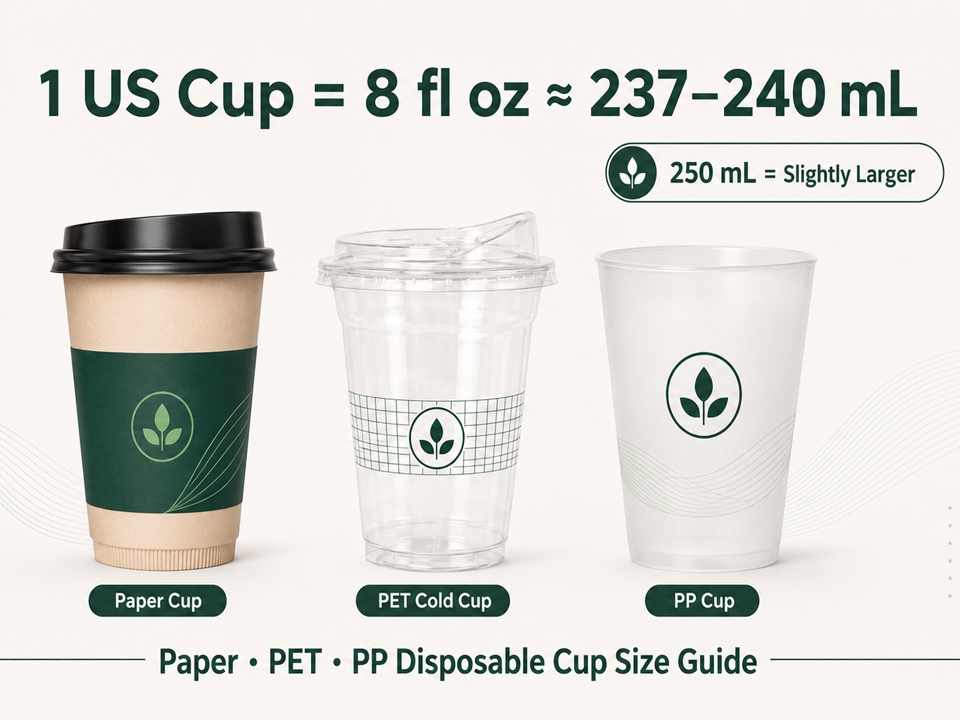
There are 8 fluid ounces in 1 U.S. cup.
That’s the easy bit.
Put the same number on a disposable-cup RFQ, though, and things get less tidy. One U.S. cup is roughly 237 mL; for everyday food and cooking references you’ll very often see that rounded to 240 mL. Then a supplier sends over a “250 mL” cup and somebody asks whether it’s basically the same thing.
Basically? Maybe.
Exactly? No.
For a recipe, a few milliliters rarely change much. For commercial cup sourcing—where you’re dealing with a fixed drink recipe, rim tooling, lid fit, brimful capacity, working fill and sometimes automated sealing—that little difference can suddenly become something worth discussing.
And this is the part I think gets missed in most conversion articles: “8 oz” describes capacity, not the entire cup.
You still don’t know the resin. Or wall structure. Or rim OD. Or nest height. Or whether the cup is designed around a flat lid, dome lid, sip lid, film seal, or no closure at all.
Then there’s the drink itself.
Coffee is one brief.
Milk tea with pearls is another.
How Many Oz in a Cup? The Quick Conversion
For U.S. liquid volume:
1 cup = 8 fluid ounces
Simple enough.
The NIST Metric Kitchen uses practical equivalents of 240 mL = 1 cup, 120 mL = ½ cup, 60 mL = ¼ cup, and 480 mL = 2 cups.
I’ve seen cup conversations become needlessly confusing because everyone agrees that 16 oz means 16 oz, then discovers later that one person was talking about nominal capacity, another was looking at a brimful drawing, and the beverage operator actually needed a specific working fill below the lid line.
Same number. Three conversations.
That’s why the conversion chart is step one—not the purchase order.
Is 8 oz the Same as 240 mL or 250 mL?
Not quite.
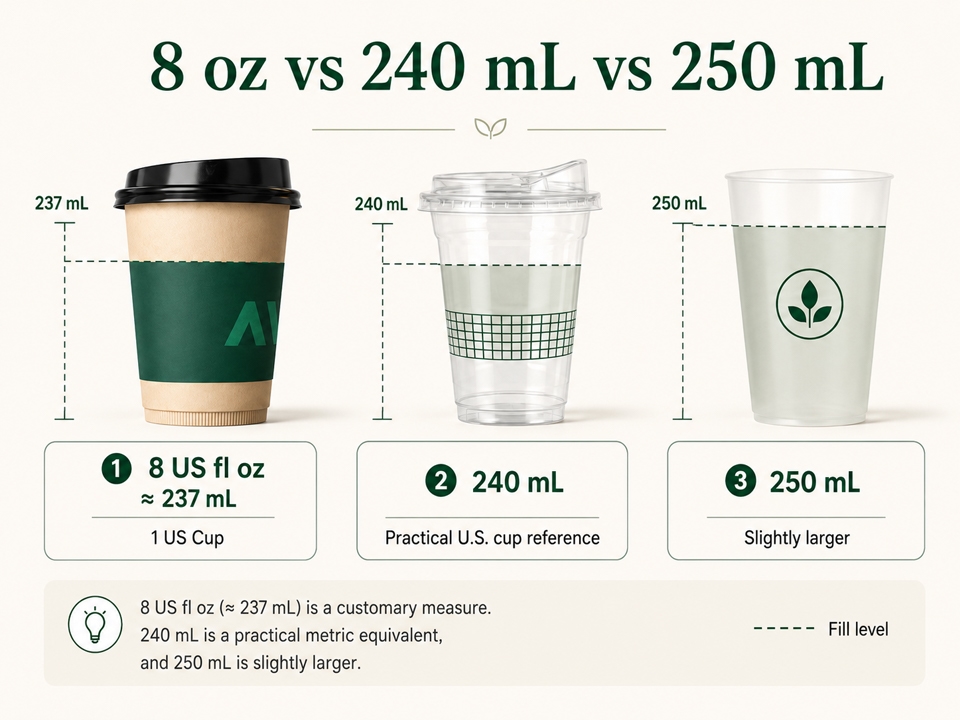
Eight U.S. fluid ounces comes out at roughly 237 mL. For practical kitchen and labeling purposes, 240 mL is the familiar rounded figure.
Then you have 250 mL.
Marked Capacity
Relationship to 1 US Cup
Practical Difference
8 US fl oz
1 cup
Standard U.S. reference
240 mL
About 1 cup
Common rounded metric equivalent
250 mL
Slightly over 1 cup
About 10–13 mL more
Ten or thirteen milliliters isn’t much when there’s plain water in the cup.
Now put ice in it.
Then foam.
Maybe three slices of lemon, a scoop of nata de coco, some pearls, and a dome lid that needs a clean area around the rim so the operator can actually snap it down without making a mess.
Different calculation.
That extra headspace has to come from somewhere.
This is also where I get a little suspicious of catalog comparisons that treat “8 oz,” “240 mL,” and “250 mL” as three labels for exactly the same mold. Sometimes they are being used loosely for products in the same size class. Sometimes they aren’t.
Check the drawing.
The older NIST household-measure reference also helps explain why the approximately 237 mL customary cup keeps appearing alongside rounded metric cup figures.
If a customer has written 250 mL in the sourcing brief, I’d keep it that way.
Don’t silently convert their requirement to “8 oz” because the numbers look close. Quote the requested volume first; if you’ve got an 8 oz mold that may work, show it as an alternative.
Cleaner that way.
Why the 8 oz Cup Matters in Foodservice Packaging
Eight ounces is small enough to sound simple.
It isn’t always.
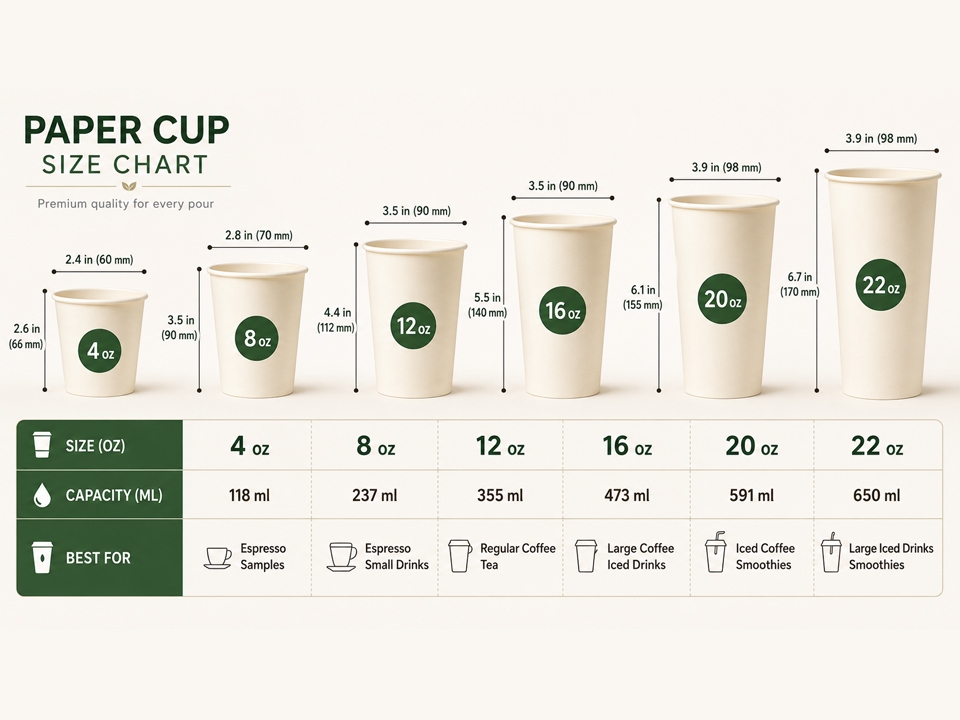
For coffee, it may suit a compact hot-drink serve, office coffee station, hotel breakfast setup or tasting program. For juice or other cold beverages, an equivalent size can work for controlled portions and sampling.
But someone saying “send me your 8 oz cups” still leaves half the job unanswered.
Hot or cold?
Paper, PET or PP?
Flat lid or dome?
Existing lid family?
Printed?
Unprinted?
A supplier can guess, of course. I’d rather not.
When the project involves more than one SKU, it makes more sense to work through the full cups, lids and straws range and build around the beverage rather than shopping for an isolated cup body first.
Because, awkwardly enough, the cup itself isn’t always what causes trouble.
The lid often does.
The samples can look perfect sitting empty on a desk. Then somebody fills the cup, pushes on the lid and finds that the lock is mushy, the skirt is too tight, or the closure pops off when the sidewall gets squeezed.
That’s an expensive little surprise once cartons are already packed.
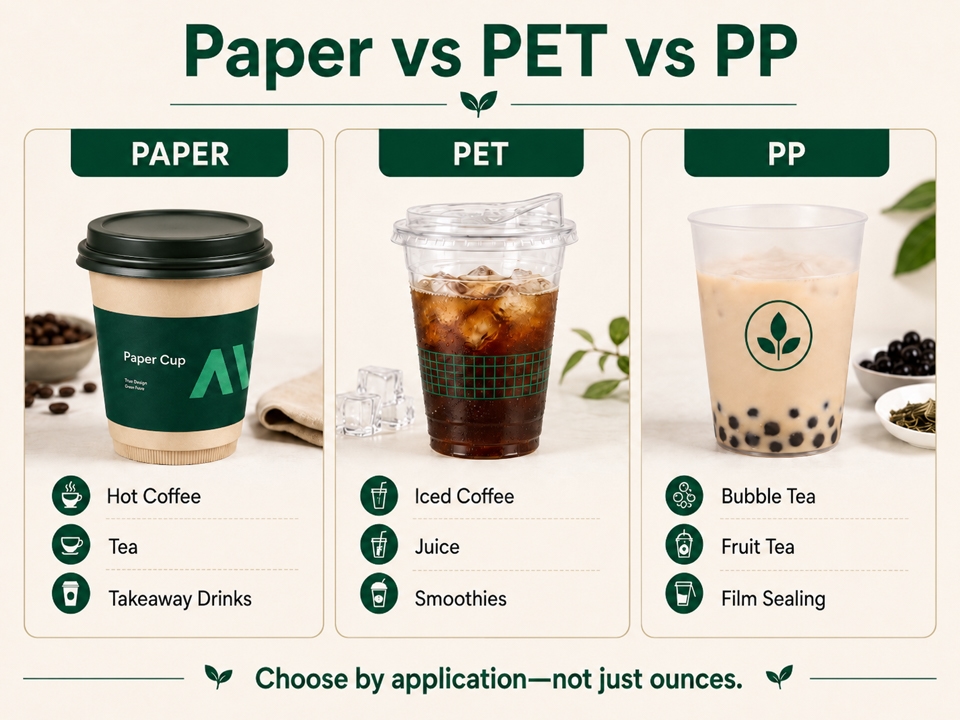
Paper vs PET vs PP: Which Disposable Cup Fits the Drink?
Here’s how I’d do it: ignore the material for a minute.
What’s being served?
That question usually gets you closer to the right cup than starting with “paper versus plastic.”
Cup Type
Typical Applications
What Buyers Should Compare
Paper Cup
Coffee, tea, hot drinks, branded takeaway
Wall structure, coating, printing, lid fit
PET Cold Cup
Iced coffee, juice, smoothies, bubble tea
Clarity, rim size, flat/dome lid, cold-use requirements
PP Cup
Milk tea, fruit tea, juice, smoothies, chilled beverages
Cup rigidity, rim profile, sealing film, lid options
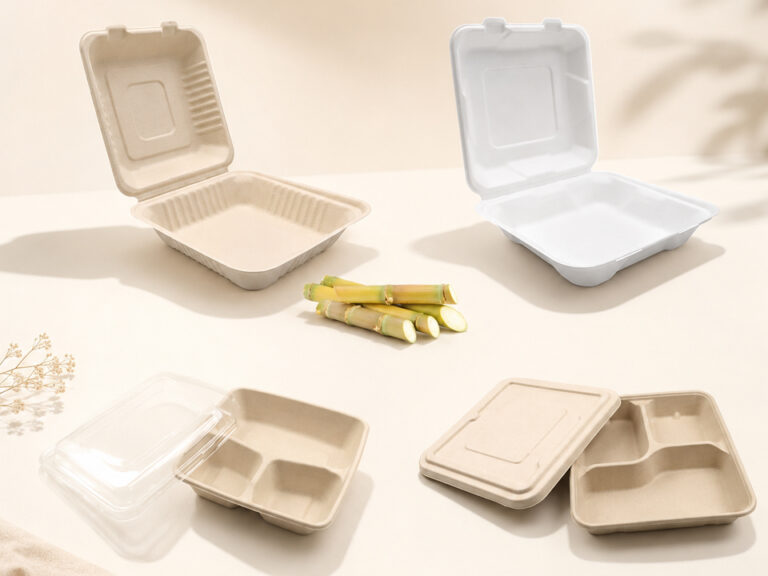
Bagasse Sauce Cup
Sauces, dips, condiments, tasting portions
Portion volume, lid style, fiber structure, food application
All cups.
That’s about it.
Paper Cups for Coffee, Tea and Takeaway Drinks
Coffee first.
If it’s being served hot, paper cups are the obvious place I’d start looking.
But “8 oz paper cup” is still pretty thin as a specification. A buyer may need single-wall construction for one program and double-wall for another; printing coverage changes, coatings change, lids change, and even a small difference in the finished beverage can make the originally selected volume feel cramped.
I’ve never been keen on sizing coffee cups from the menu label alone.
“Small” doesn’t tell me much.
A black coffee might sit comfortably in an 8 oz format. Add steamed milk, foam and syrup and suddenly that same size can feel tight—particularly when the barista needs enough room at the top to avoid wearing the drink while fitting the lid.
Then 12 oz starts looking sensible.
Maybe 16.
The recipe decides.
PET Cold Cups When Product Visibility Matters
Ever notice how much of a fruit tea’s appeal is visual?
You can see the citrus. The ice. The layers. The color.
That’s why PET cold cups are such a natural fit for iced coffee, juice, smoothies, fruit tea and other cold drinks where the product itself is part of the display.
Clear cup. Clear benefit.
Still, I’d never send an RFQ saying only “16 oz clear PET cup.”
Which rim family?
Which lid?
Flat or dome?
How much dome clearance?
What cup height works with the carrier?
What’s the sleeve count?
Will the logo be printed?
And if there’s already a lid in the customer’s warehouse, can the new cup actually lock into it?
That’s the one that catches people.
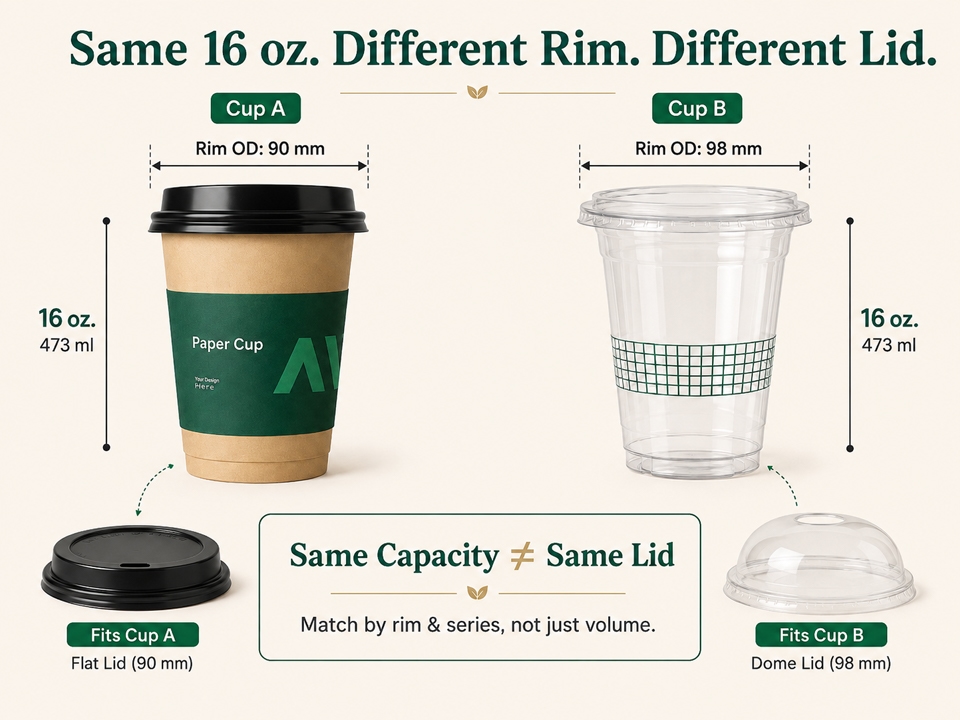
A 16 oz cup isn’t paired with a lid because the lid is somehow also “16 oz.” Capacity has almost nothing to do with the actual locking interface.
Rim geometry does.
PP Cups for Bubble Tea and Flexible Beverage Programs
Now bubble tea.
Things get interesting fast.
PP cups can make sense for milk tea, fruit tea, juice, chilled drinks, desserts and beverage programs built around film sealing or matched lids.
But I wouldn’t lump them into one generic “plastic cup” category with PET.
Too vague.
A bubble-tea operator might need a film-sealable rim. Another uses a flat lid with a large straw slot. A third has fruit chunks big enough that a normal straw is almost useless.
And then there’s the sealer.
The cup may photograph beautifully, stack nicely and feel perfectly respectable in your hand, yet none of that matters much if the rim doesn’t run properly with the customer’s film and sealing setup.
That’s production reality.
Not glamorous, but real.
There’s also a big difference between checking a cup empty and checking it full. Put 600 or 700 mL of liquid, ice and toppings into a taller format and suddenly wall flex, grip and lid retention become much easier to notice.
No spreadsheet catches all of that.
Bagasse Sauce Cups: Ounces Matter Outside Beverage Cups Too
Not every “cup” holds coffee.
Drop down to 2 oz or 4 oz and you’re often talking about sauce, dressing, ketchup, dip, condiment or a sample portion instead.
I’m not worried about straw bore here. I’m looking at whether the molded fiber holds up against oily dressing, how the rim behaves when the lid is pressed on, how the cups nest, and whether the portion cup keeps its shape through the intended holding time.
Completely different brief.
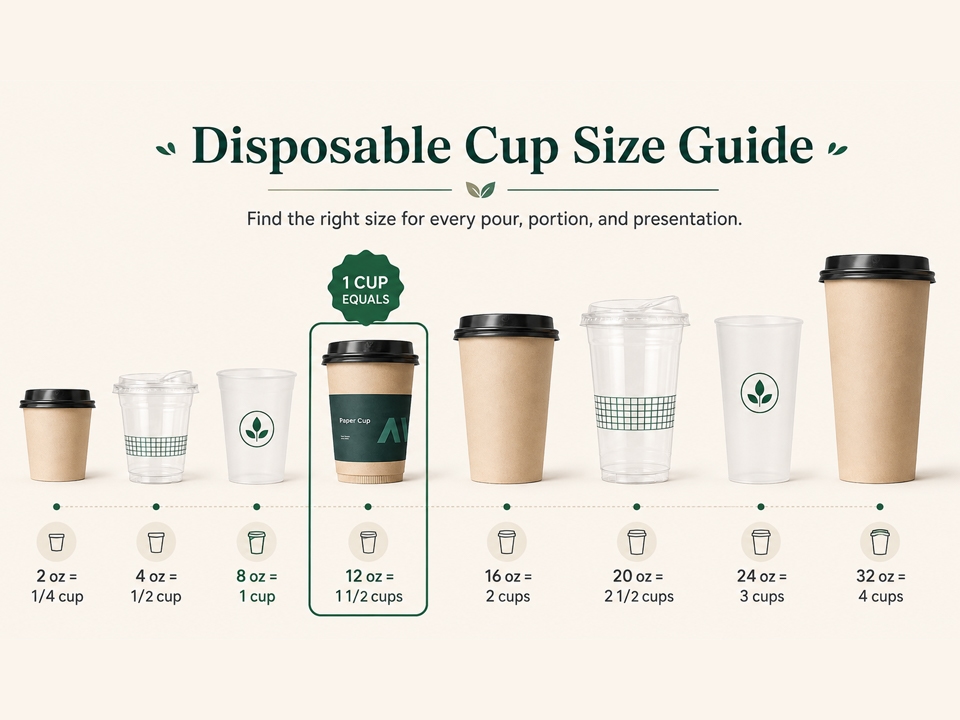
8 oz vs 12 oz vs 16 oz vs 24 oz: Which Cup Size Should Buyers Choose?
People ask for the “best cup size.”
I always want to add two words:
For what?
Cup Size
Cup Equivalent
Typical Beverage Role
Procurement Question
8 oz
1 cup
Small coffee, tea, samples
Is the portion intentionally compact?
12 oz
1.5 cups
Coffee, latte, juice
Enough room for recipe + foam/ice?
16 oz
2 cups
Iced coffee, milk tea, smoothies
What lid, straw or seal is required?
20 oz
2.5 cups
Large takeaway drink
Will the same lid series fit?
24 oz
3 cups
Large cold drink, bubble tea
Enough headspace for ice/toppings?
32 oz
4 cups
Extra-large cold beverage
Is the cup stable after filling?
The table gets you into the right neighborhood.
After that, stop looking at ounces for a minute.
A taller 24 oz cup behaves differently from an 8 oz cup once it’s loaded because the filled mass is higher, the leverage in the hand changes, sidewall movement becomes easier to feel, and a marginal lid fit that barely showed up on a small sample can become painfully obvious in a large takeaway drink.
That’s physics.
A 24 oz plain iced tea?
Fairly forgiving.
Now make it fruit tea with ice, citrus slices, jelly, nata de coco and a high dome. The cup has more going on above, below and right at the rim.
Different animal.
By 32 oz, I’d pay even more attention to cup stiffness, how the customer actually grips it, closure retention and transport. Large formats can look fine while empty and then feel decidedly less impressive once there’s nearly a liter of beverage inside.
Fill testing matters.
Cup Capacity Does Not Tell You Which Lid Fits
Here’s the line I’d happily put on every sourcing sheet:
An “8 oz lid” isn’t a technical specification.
It just isn’t.
Capacity tells us how much the cup is supposed to hold. The lid has to engage with the top rim, so what matters is the outside diameter, rolled or molded rim profile, locking ring, skirt depth, material response and the geometry of that particular tooling set.
That’s why the cup lid should be matched to the actual cup series.
Say you’ve got two 16 oz cups.
One is built around a 90 mm rim.
The other is 98 mm.
Easy call.
But even two “90 mm” products can still be a headache if they’re from unrelated molds. Same nominal OD doesn’t necessarily mean the closure geometry underneath is the same.
Those tiny details matter.
Rim roll.
Lock bead.
Skirt engagement.
Material stiffness.
Tolerance.
Not exactly exciting marketing copy—but that is what keeps a lid on a cup.
I frankly believe cup-and-lid sourcing should be treated as a matched-set exercise whenever possible:
Cup + matched lid set, tested together
rather than:
100,000 cups + 100,000 lids
Looks like semantics.
It isn’t.
Cold-drink closures alone can mean flat lids, dome lids, open domes, straw slots, direct-drink designs, topping-friendly openings and other variants. Move into hot beverages and now you’re talking about venting, sip openings, heat exposure and how the lid behaves immediately after filling.
Capacity didn’t answer any of it.
What to Specify When Ordering Disposable Cups Wholesale
Here’s an RFQ I wouldn’t want to base a serious comparison on:
Need 16 oz cups. Quote 100k pcs.
Can you get a quote from that?
Of course.
But there’s a good chance two suppliers won’t be quoting the same thing.
And then you end up comparing prices that were built from different assumptions.
Not useful.
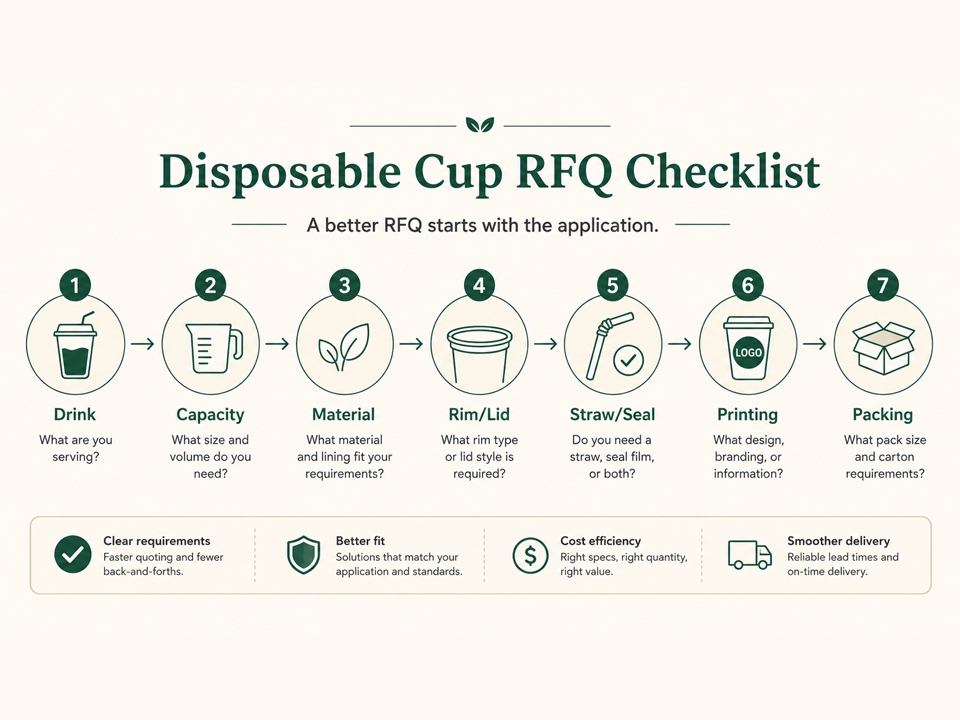
A cup RFQ doesn’t have to read like an engineering manual. Give the supplier the handful of details that actually move the specification.
1. Capacity
Start with what you need.
For example:
16 oz / approximately 473–480 mL
If the requirement is for usable working fill rather than brimful volume, spell it out. I know that sounds fussy, but it’s less fussy than arguing about it after a sample mold has already been approved.
One line now.
Fewer problems later.
2. Beverage or Food Application
I’d rather see:
fruit tea with ice and citrus
than:
cold drink
Every day of the week.
A cold brew, lemonade, milk tea and thick smoothie all sit under “cold beverage,” yet their cup-and-closure requirements can be miles apart.
If there are toppings, say so.
If it’s greasy sauce, say so.
The product inside is not a minor detail.
3. Material
Paper.
PET.
PP.
Bagasse.
If you genuinely don’t know which material fits the program, that’s fine—ask for options. But don’t expect the phrase “plastic cup” to narrow the field very much.
It won’t.
And if the customer’s current SKU is PET but they’re open to PP, make that explicit instead of allowing a supplier to assume substitution is acceptable.
4. Rim Diameter and Lid
Got a technical drawing?
Great.
Got only the cup?
Still useful.
Got the lid but no cup code?
Send it.
Even a decent photo with a caliper across the outside rim can be more informative than writing “standard 16 oz lid” three times in an email.
Standard to whom?
That’s always my question.
5. Straw or Sealing Requirement
This one’s easy to overlook until the beverage includes chunks.
A normal straw for iced tea may be hopeless with pearls or jelly. A film-sealed PP program has another issue entirely: the cup rim, sealing film and machine settings have to work together.
Three moving pieces.
Not one.
So if there’s a sealing machine already installed, mention it. If the buyer has a preferred film, mention that too.
Better to learn about the constraint before sampling.
6. Branding
Custom logo?
Good start.
Now tell the supplier something they can quote.
logo artwork
print colors
approximate print coverage
private-label packing
barcode requirements
shipping marks
A small one-color logo and a near-full-wrap multicolor graphic are both “custom printing.”
They’re not the same print job.
7. Packing and Commercial Requirements
And then we get to the unsexy stuff.
The stuff that actually matters once the order ships.
estimated quantity
pieces per sleeve
sleeves per carton
destination market
sample requirement
pallet or floor-loading preference
required documents
target delivery window
I’d include those early.
Already using another cup?
Even better—send the SKU, drawing, sample or measurement sheet. An existing reference product can wipe out ten rounds of vague questions.
A cup of water and a cup of sugar occupy a comparable volume, but nobody should expect them to behave like the same eight ounces by weight.
For disposable-cup specifications, fl oz is the clearer wording whenever there’s room for confusion.
It’s two letters.
Keep them.
FAQs
How many ounces are in a cup?
One U.S. cup equals 8 fluid ounces. You’ll also see the volume written as roughly 237 mL for the customary U.S. cup or rounded to 240 mL in practical food and cooking references.
For disposable cups, that’s a size reference—not enough information to approve a product. I still want the actual dimensions and matched lid.
Is an 8 oz disposable cup the same as 1 cup?
In terms of U.S. liquid volume, yes: 8 fluid ounces equals 1 cup.
Would I therefore assume any two disposable 8 oz cups are interchangeable?
No.
The rim, cup height, material, working fill and lid system may be completely different. Check the SKU—not just the ounce label.
Is 240 mL equal to 1 cup?
For practical U.S. food and cooking conversions, yes. The NIST Metric Kitchen uses 240 mL as the approximate equivalent of 1 cup.
The customary cup itself is a little closer to 237 mL.
Does that tiny gap bother me in a kitchen conversion?
Usually not.
Would I change a customer’s 240 mL product specification to 237 mL without telling them?
Absolutely not.
Is 250 mL the same as 8 oz?
Not exactly. Eight U.S. fluid ounces is roughly 237 mL, while a 250 mL cup gives you a little more volume.
Small difference.
Still a difference.
If 250 mL appears on the customer’s brief, keep it there. An 8 oz option can be offered alongside it if needed rather than quietly treating both as the same capacity.
Which cup is better for coffee: paper, PET or PP?
For hot coffee and tea, paper cups are usually the first material I’d look at; PET and PP are more often associated with cold-beverage setups.
But I’d rather know the drink than argue about material in isolation.
Hot-fill temperature, wall construction and sip-lid fit matter for coffee. Ice, clarity, toppings, dome space and sealing method start taking over once we’re talking about cold drinks.
Are PET cups and PP cups the same?
No. PET and PP are different polymers, even though both can be used to make disposable cold-drink cups.
They can look deceptively similar in a catalog photo, especially when both are clear.
That’s why I wouldn’t approve one as a replacement for the other from appearance and ounce capacity alone. Check the exact application, rim, closure or seal, rigidity and finished cup sample.
Does the same lid fit every 8 oz cup?
No. The same capacity doesn’t guarantee the same rim, so two 8 oz cups may need completely different lids.
This applies beyond 8 oz, too.
If you’re trying to match an existing closure, send the cup code, rim OD, drawing or sample. Guessing from “16 oz” is a poor shortcut.
Start with the drink or food, cup capacity, preferred material, lid or sealing setup, printing, quantity and destination market.
That’s usually enough to expose the important questions.
And if there’s an existing cup you want matched? Send it. A SKU or physical sample beats a long description every time.
Choose the Cup by Application, Not Just the Ounce Number
So the math stays simple:
1 U.S. cup = 8 fluid ounces.
Done.
Except that’s not how I’d buy a cup.
An 8 oz paper cup serving coffee and an 8 oz PET cold cup serving juice may carry exactly the same capacity figure while sharing almost nothing else about construction or closure.
Switch to a PP cup on a milk-tea sealing line and the brief changes again.
Go smaller with bagasse sauce cups and now we’re worried about portion control, oil resistance and molded-fiber performance.
Same word.
“Cup.”
Quite a lot hiding behind it.
If I were setting up the RFQ, I’d work in this order:
application → capacity → material → dimensions → rim → lid → straw/seal → branding → packing
It isn’t as quick as searching “16 oz cup” and sorting by price.
Good.
Because a cent saved on the cup body isn’t particularly clever if the lid doesn’t lock properly, the usable fill misses the beverage recipe, or the customer discovers after delivery that their sealing setup doesn’t run with the chosen rim.
That’s the ugly version.
I’d rather catch it on the spec sheet.
If you’re sourcing a full beverage setup, start with what you’re actually serving, then compare the cups, lids and straws around that use rather than forcing the drink into whatever cup happens to have the right ounce number.
Need a cup, lid and straw combination for a specific beverage program? Send the target capacity, drink type, destination market, lid or sealing requirement, printing needs and expected order quantity to compare suitable wholesale options.