




A buyer once sent me a “simple” request.
Simple, supposedly.
They wanted custom bagasse tableware with a private logo, a different tray shape, a warmer beige tone, a new compartment layout, tight carton artwork, PFAS-free documentation, FDA food-contact support, retail-ready barcodes, and a launch order small enough to “test the market” without any real volume commitment.
Sound familiar?
Here’s the ugly truth: in molded fiber, “custom” can mean a printed carton that costs almost nothing to change, or it can mean a new tooling project that eats cash, sampling time, and engineering patience before one usable tray comes off the line. Same word. Completely different risk.
That’s where buyers get burned.
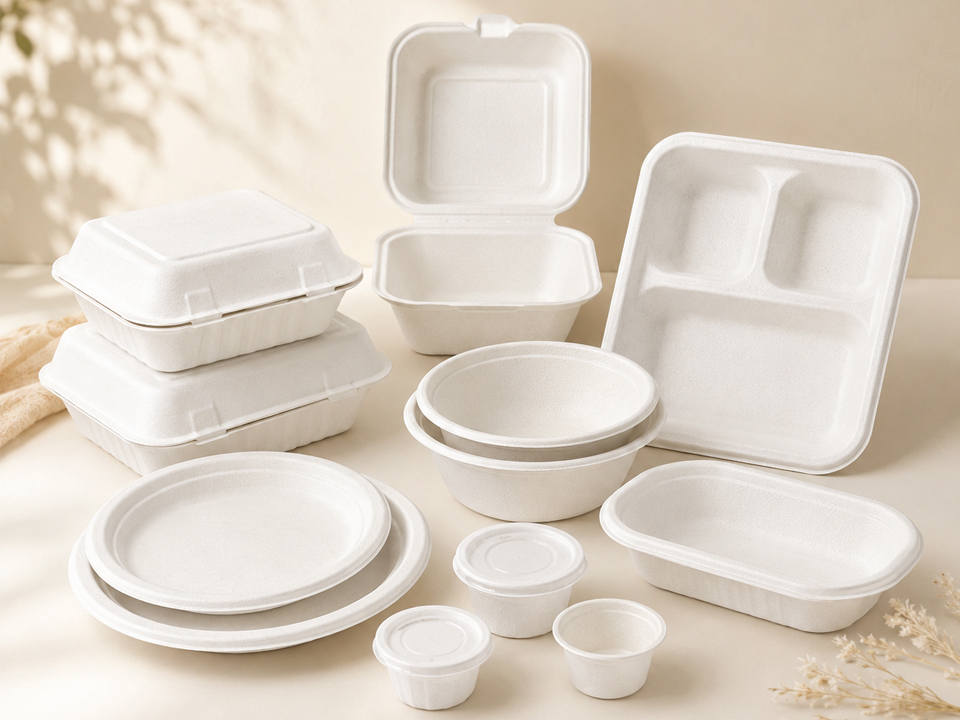
I frankly believe this: 70% of custom bagasse tableware projects should not start with a new mold.
Start with the boring stuff first. Cartons. Sleeves. Stickers. Assortment packs. Case labels. Maybe light embossing if the structure allows it.
Not glamorous.
But it ships.
And yes, the market pressure is not imaginary. The EPA’s containers and packaging data puts U.S. containers and packaging generation at 82.2 million tons in 2018, equal to 28.1% of total municipal solid waste generation. That number explains why foodservice buyers, chain restaurants, importers, and private-label category managers keep asking for fiber-based packaging instead of another plastic tray. Less plastic on the spec sheet. Less trouble in ESG meetings. A cleaner story for procurement to defend.
But pressure doesn’t make pulp behave like plastic.
Bagasse has its own temper. Pulp flow. Shrinkage. Rim cracking. Lid-fit tolerance. Wet-end variation. Drying marks. Stack height drift. Grease-resistance limits. If you treat it like injection-molded PP, you’ll write a beautiful spec and receive an ugly shipment.
And yes, I’ve seen it happen.
Custom bagasse tableware means sugarcane-fiber foodservice packaging modified for a buyer’s brand, food application, sales channel, or operational workflow through packaging artwork, logo embossing, size selection, compartment changes, color adjustment, or full mold development.
That sentence sounds neat.
The factory floor isn’t.
A logo on a master carton? Low drama. A belly band for retail shelves? Fine, assuming paper, glue, humidity, and carton compression are handled properly. A custom tray mold with three food zones, a sauce well, a raised rim, tight lid closure, and no warping after hot rice sits inside for 45 minutes?
Different animal.
That’s why I split customization into levels instead of saying “yes, we can customize.” A serious supplier should do the same.
| Customization Type | Typical Risk Level | Cost Pressure | Best For | Buyer Warning |
|---|---|---|---|---|
| Branded master carton / case mark | Low | Low | Importers, distributors, club packs, private-label wholesalers | Check ECT/BCT strength, barcode position, country-of-origin wording, and pallet label layout before printing |
| Printed sleeve / belly band | Low | Low to medium | Retail packs, catering bundles, supermarket grab-and-go trays | Paper stock, glue line, humidity, and scuffing matter more than the PDF artwork |
| Embossed logo on the product | Medium | Medium | Restaurant chains, premium takeout, brand-owned foodservice programs | Too much logo depth can weaken the wall, trap oil, or make stacking ugly |
| Custom size or compartment layout | High | High | Meal prep, airline catering, school lunch, central kitchen programs | Requires mold trials, lid-fit checks, portion tests, and real food loading |
| Full new molded fiber tool | Very high | Very high | Mature private-label programs with repeat volume | Don’t touch this unless demand, margin, and reorder plan are already proven |
That table is not theory. It’s how sourcing risk usually shows up.
Quietly at first.
Then all at once.
Want my practical answer? Start with logo packaging.
Take a buyer using a standard molded fiber clamshell takeout food box. Most of the time, that buyer can get a proper private-label look by changing the outer carton, inner pack label, barcode sticker, sleeve, or case mark. No need to mess with the food-contact surface on day one. No need to turn a simple launch into a compliance puzzle.
That’s not a small detail.
Once you change the actual product surface, especially with ink, coating, colorant, or embossing, you may create new questions around food-contact use, migration risk, and test scope. Packaging artwork is safer. Product-level modification needs more caution.
Embossing? I like it, but only when done lightly.
A deep logo stamped into a bagasse plate can look premium in a sample photo and still cause problems in real production. The wall gets thin. The surface gets fuzzy. Stacking becomes uneven. Oil collects in the wrong place. The logo edge starts looking like wet cardboard after 20 minutes under saucy food.
Pretty mockups are cheap.
Functional samples are not.
So if you’re ordering custom logo bagasse plates, don’t approve from a 3D rendering. Ask for physical samples. Stack them. Rub the embossing. Put hot oily food on them. Close the lid, if there is one. Leave it for 30 minutes. Then check the rim, base, leakage, odor, and sagging.
That’s the real inspection.
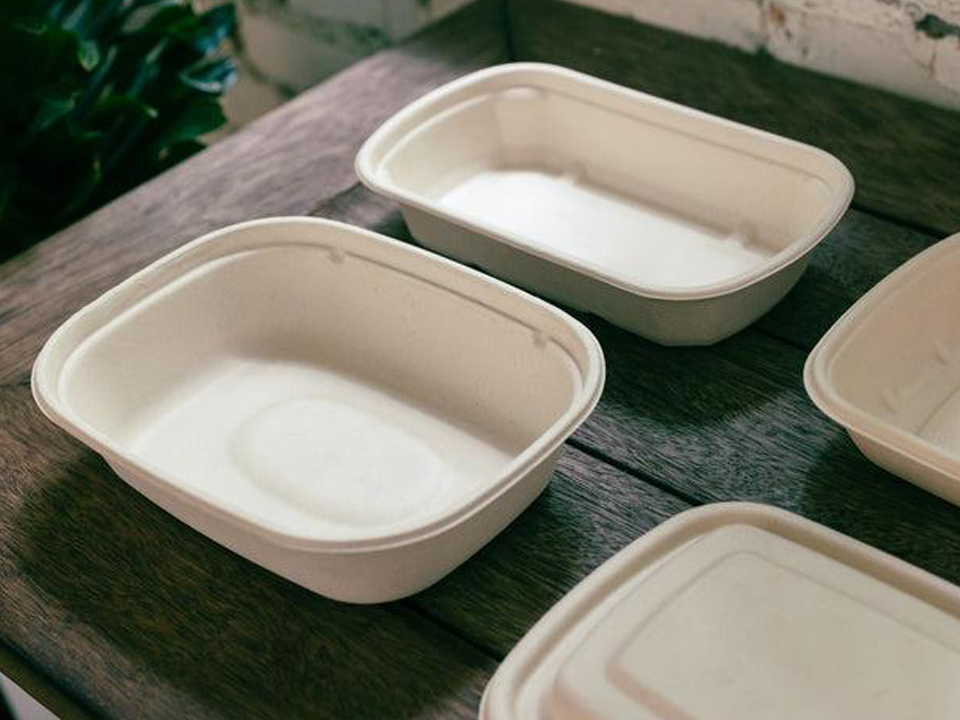
A new bagasse mold is not just a mold.
It’s a commitment.
You’re paying for design work, forming logic, hot-press matching, prototype adjustment, sample rejection, re-sampling, mold polishing, mold trial loss, testing, and then the uncomfortable part nobody likes to discuss: production yield. A tool can technically “work” and still be commercially annoying.
From my experience, buyers underestimate this part because they think a molded fiber tool is like a cookie cutter. It isn’t. Molded pulp has draft angles, drainage behavior, shrinkage, local thickness variation, demolding behavior, and drying constraints. The food packaging has to survive not only production but packing, container loading, warehouse storage, restaurant use, and delivery abuse.
A custom tray drawing doesn’t prove anything.
A loaded tray after transport does.
Say you want a four-compartment takeaway tray. If your product is close to an existing bagasse 4-compartment meal tray with lid for takeout, don’t rush into a new tool. First check whether the current mold already solves 80% of the job. Can the lid fit your food height? Does the compartment split work? Is the carton count acceptable? Can the outer packaging carry your brand?
If yes, you may not need OEM mold development at all.
And that’s not settling.
That’s discipline.
Some buyers ask for “natural beige” as if bagasse were a controlled fashion fabric.
It isn’t.
Natural bagasse color changes with pulp source, bleaching level, moisture, fiber mix, pressing temperature, drying cycle, and storage condition. One batch may lean cream. Another may look slightly gray. Another may be warmer, especially under warehouse lighting.
Can custom color sugarcane tableware be made? Sometimes, yes.
Should every buyer do it? No.
Colorants can complicate food-contact review. Darker shades may show fiber streaks, surface scratches, oil marks, or batch variation. Light colors can expose pulp inconsistency. And if the item is going into U.S. retail, California distribution, or EU foodservice, the color decision should sit inside the compliance discussion, not outside it.
The FDA’s food packaging and food-contact substances page makes the basic boundary clear: food-contact substances include packaging components, adhesives, colorants, coatings, antimicrobials, and similar substances that contact food. Some are considered indirect food additives.
Translation for buyers?
Don’t treat color like decoration.
Treat it like part of the material system.
One centimeter can be expensive.
Really.
A slightly wider tray may reduce case quantity. A taller bowl may lower pallet efficiency. A custom clamshell depth may create carton bulging. A new lid height may improve food presentation but kill container load economics.
That’s the part buyers miss when they focus only on unit price.
Custom size bagasse food containers need to be judged by landed cost, not factory unit cost. Carton cube. Pallet height. Container fill. Damage rate. Food fit. Storage efficiency. Restaurant shelf space. These dull details decide whether a “custom” product makes money or just looks nice in a sourcing deck.
For many foodservice programs, an existing 3-compartment bagasse plate for foodservice supply will outperform a custom plate simply because it already fits production, packing, and logistics flow.
Less ego.
More margin.
Before changing a size, ask:
How many pieces per inner pack?
How many pieces per master carton?
How many cartons per pallet?
Will the lid still close after hot food expands or shifts?
Will the buyer accept the case cube?
Nobody puts those questions on a glossy catalog page. They should.
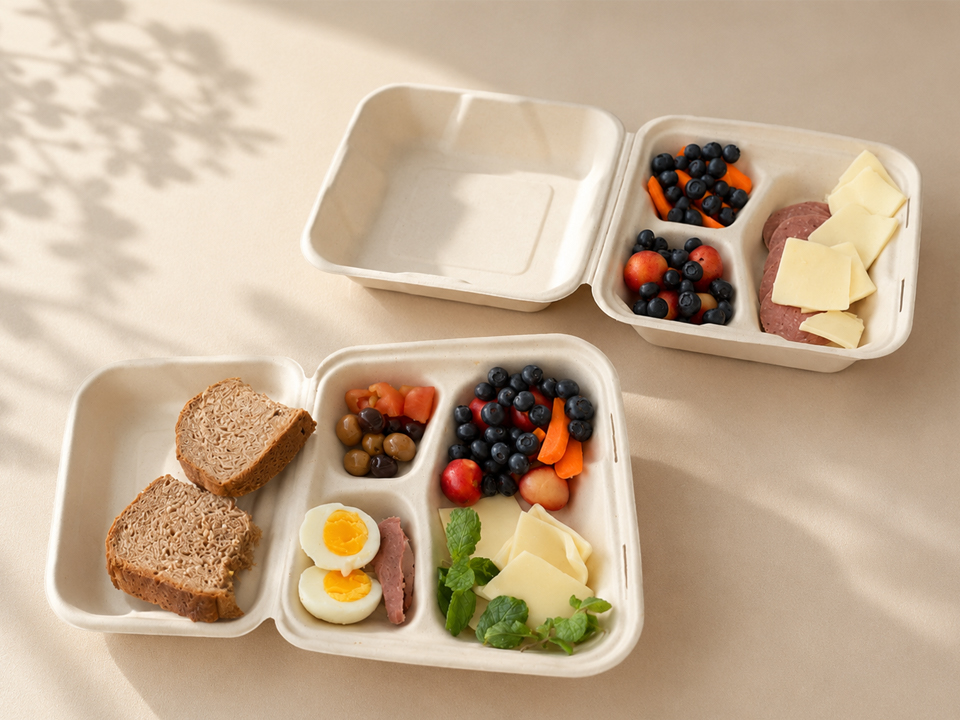
Here’s another sourcing trap: buyers use private label bagasse tableware and bagasse tableware OEM as if they mean the same thing.
They don’t.
Private label usually means you use a factory’s existing mold and customize packaging, labels, barcode, brand artwork, carton marks, case packs, and sometimes the sales bundle. OEM goes deeper. New size. New shape. New mold. Special embossing. Custom compartments. Color changes. Material or performance adjustments.
A buyer sourcing a 3-compartment bagasse style clamshell takeout box may not need OEM at all. They may need sharp packaging design, clean spec sheets, reliable lead time, and a compliance file that doesn’t collapse when a retailer asks three questions.
That’s enough in many cases.
Full OEM sounds serious. Sometimes it is. Other times it’s just an expensive way to delay your launch by months.
I don’t care how good the logo looks if the compliance file is thin.
For bagasse tableware, you need to know the target market before approving the customization route. U.S.? California? EU? UK? Canada? Foodservice chain? Retail shelf? Compostability claim? PFAS-free claim? Microwave claim?
Each one adds pressure.
BPI says BPI-certified compostable products are verified against ASTM standards for compostable products in North America. The certification program is not just a marketing badge; it ties compostability claims to recognized testing and program requirements.
California is even more direct. The state’s Department of Toxic Substances Control page on food packaging containing PFAS explains that AB 1200 bans plant fiber-based food packaging containing PFAS, including intentionally added PFAS or PFAS at or above 100 parts per million as measured by total organic fluorine.
That matters for bagasse.
A lot.
And Europe is tightening the screws too. Reuters reported that EU negotiators reached a deal with packaging waste reduction targets of 5% by 2030 and 15% by 2040, with all packaging required to be recyclable by 2030. The European Parliament also noted in its April 2024 packaging rules update that each European generates almost 190 kg of packaging waste per year.
So no, a supplier saying “eco-friendly, don’t worry” is not enough.
Worry.
Then verify.
Most sourcing briefs are too vague.
They say: “Need custom bagasse tray, logo, FDA, compostable, good price.”
That’s not a brief. That’s a headache in sentence form.
A useful brief should include food type, serving temperature, holding time, delivery time, grease level, sauce level, lid requirement, target market, annual volume, first order quantity, carton quantity, pallet preference, artwork format, certification expectations, and whether the buyer wants private label or true OEM.
Overkill?
Not if money is involved.
Tell the supplier what food goes inside. Rice, pasta, curry, salad, fried chicken, steak, fruit, sauce, soup-adjacent food, cold meals, airline meals, meal prep portions. Different foods punish packaging differently.
Separate carton logo, sleeve artwork, sticker, inner label, barcode, embossed logo, and molded product shape. Don’t hide six requests inside the words “custom logo.”
Say whether you want an existing mold, a modified existing mold, or a full new mold. If you’re unsure, ask the supplier to quote all three routes with MOQ, tooling cost, sample time, mass production lead time, and risk notes.
List every selling market. U.S. national distribution is one thing. California is another. EU is another. A local restaurant chain is not the same as a national retailer with a QA team.
Give annual forecast, first launch order, reorder rhythm, target landed cost, carton quantity, and expected sales channel. Without volume, mold development is just guessing with metal.
Don’t start with the dream product.
Start with the sellable product.
First, pull the closest standard mold off the shelf. Not the prettiest one — the one that already stacks, nests, dries cleanly, closes with a lid, and survives a carton drop without the rim looking chewed up. Then brand the packaging, test the product with real food, and let the first buyer feedback tell you whether the mold deserves more money.
It works. Usually.
And when it doesn’t, you find out early enough to avoid burning tooling money on a tray your end customer may not even reorder.
My preferred sequence is rough, but it keeps buyers out of trouble:
That last step is the expensive one.
Make it earn its place.
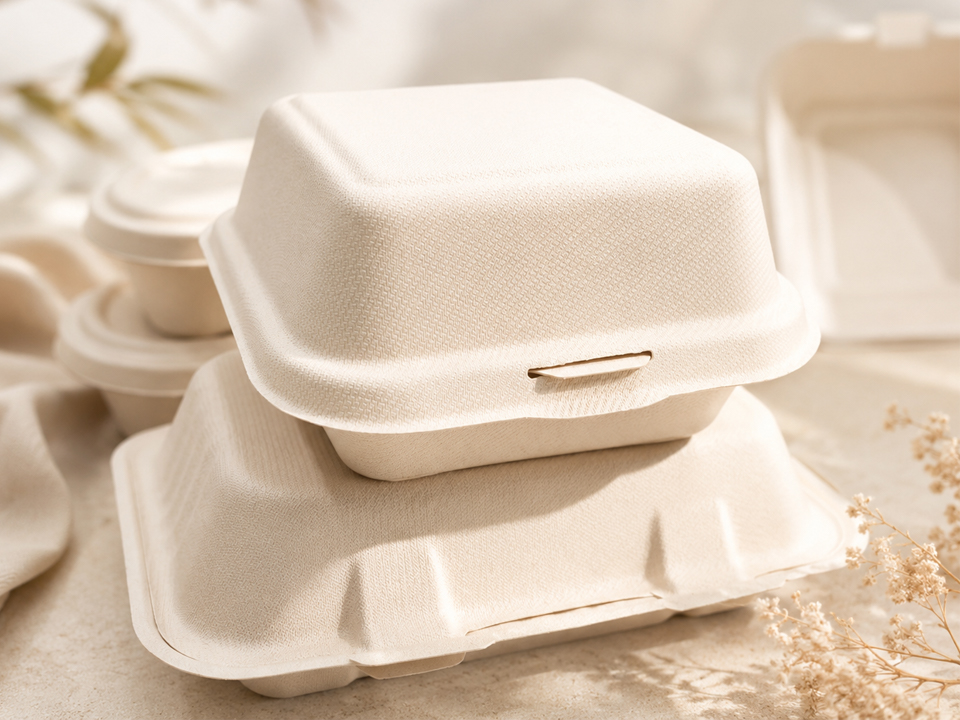
Custom bagasse tableware is molded sugarcane-fiber food packaging adjusted for a buyer’s brand, food use, sales channel, or compliance market through case printing, sleeves, labels, embossing, color control, size changes, compartment design, or new tooling.
In plain English, it can be a branded carton. It can also be a full tool build with sample rounds, yield issues, and test-report headaches. Those two projects should never be quoted, timed, or approved as if they are the same job.
A logo can often be added to bagasse plates or clamshells through packaging print, sleeves, labels, or shallow embossing, but direct ink printing on the food-contact surface is usually not the first route I’d recommend for serious foodservice buyers.
I’d be careful here. The moment ink touches the food side, the question stops being “Does the logo look clean?” and turns into “What happens with hot oil, sauce, abrasion, stack pressure, and migration testing?” For most private-label launches, a printed carton or sleeve gets the buyer’s brand in front of the customer without turning the plate surface into a regulatory side quest.
A new mold is usually not needed for private label bagasse tableware because most buyers can use an existing factory mold and customize the carton, sleeve, label, barcode, case pack, or retail bundle first.
And honestly, that’s often the smarter route. If the existing shape already holds the portion, closes properly, stacks cleanly, and passes the buyer’s handling test, why pay for tooling just to make it “more custom”? Spend that money on better cartons, sharper artwork, stronger QA, or a bigger pilot run.
New molds belong in a narrower lane: wrong lid clearance, wrong compartment split, wrong portion fit, a channel-specific pack format, or a buyer with enough repeat volume to make the tooling pain worth it.
Private label bagasse tableware is usually an existing molded fiber product dressed in the buyer’s brand system, while OEM bagasse tableware changes the product itself through size, shape, compartment layout, embossing, color, material treatment, or full mold development.
Think of private label as the commercial wrapper around a proven SKU. OEM is surgery. You can get a better fit, sure, but now you’re dealing with tooling cost, sample rounds, mold tuning, carton recalculation, lead-time drift, and the fun little surprises that only appear once the pulp actually starts running.
Custom color sugarcane tableware is possible in some projects, but color changes can affect MOQ, food-contact review, batch tolerance, visible fiber marks, lead time, and sample approval because molded fiber does not hold color like plastic or coated paper.
Natural beige is already a moving target. One pulp batch may look warmer; another may lean gray. So don’t approve color from a screen. Ask for physical samples, check them under warehouse and restaurant lighting, and set a realistic shade tolerance before mass production.
Buyers should request food-contact test reports, PFAS-related results, compostability certification if claims are used, product specs, carton specs, material declarations, artwork confirmation, sample approval records, and market-specific compliance support before placing a custom bagasse order.
The trick is scope. A report is only useful if it matches the exact item, material, temperature condition, food type, and market you plan to sell into. A pretty certificate with no test condition is not a compliance file. It’s decoration.
If you’re sourcing custom bagasse tableware, don’t begin with “What’s your lowest price?”
Begin with the job the product has to survive.
Send the food type, target market, serving temperature, holding time, annual forecast, first order quantity, branding scope, and whether you’re after private-label packaging or true OEM mold work. With that information, we can tell you which path is sane: branded cartons, printed sleeves, case-pack customization, light embossing, standard mold selection, size review, or full bagasse tableware mold development.
Send your target product photo, compartment layout, size requirement, and market compliance needs. We’ll help separate practical customization from expensive tooling fantasy.
Leave a comments